

In the wake of a vision of global harmony courtesy of Pokemon Go, it's beyond doubt that the monster collecting series is about as popular gaming titles in existence. The iconic Pikachu is every bit as recognizable as Mickey Mouse, perhaps even more. The persistent excitement surrounding trading card values ensures almost daily Pokémon headlines. You'd be hard-pressed to find a pocket monster game that didn't sell at least a few million units. Even, unofficial Pokémon games achieve popularity every year.
However in spite of that ubiquity and popularity, some Pokémon games that are totally overlooked. These represent games that failed to receive their proper due, or were buried under the hype of the core series. These are Pokémon games stuck on ill-fated consoles or services, or were early forays onto new mediums. Frequently, they are Pokémon games that probably would have blossomed if they ever got follow-ups or contemporary re-releases. With these criteria in mind, this list will not be just one more reminder for Pokémon Conquest or the Pokémon Mystery Dungeon series. We're pulling an Excadrill.
Still, you may already know about these Pokémon games. So, before rearranging your glasses and typing 'Well,' let us just agree that these are Pokémon games for people with refined tastes, shall we?
Pokemon Ranch: The Relaxed Forerunner
An excessive number of Pokémon games focus on the battling element of the series, and far too few of them focus on the everyday realities that would come with living with a pet. Sure, modern titles include small features like these in recent entries—players may play with your monsters in camps. But I am longing for a Pokémon game more in the style of Nintendogs or The Sims.
My Pokémon Ranch (2008) for the Wii isn't it. The digital-only title is most accurately viewed as the precursor to Pokemon Home; that is, as a storage system to hold monsters from different games. Reviews from its launch said Ranch was a poor if not outright hideous game. It's not my goal to argue against these notions, but it compels me to say Ranch might be the closest we've ever gotten to a everyday life Pokémon game.
As the name suggests, the game is set on a farm where your personal Miis—get this—simply hang out with your Pokémon pals. The activities with Pokémon were simple, and a significant part of the draw was watching what your monsters might do when they're not being forced into battle. In a just world, Pokémon Ranch would have been the beginning of a beautiful franchise built on the daily joys of living your life with a small creature. But since The Pokémon Company can collect a fee for Pokémon Home now, I'm guessing we will not get a Pokémon Ranch game developed to its fullest potential. One might cry 'save us, Pokémon Pokopia!' but I also know that the upcoming Switch exclusive is as much a puzzler as it is a life sim.
Ranch came out well before Stardew Valley kicked off the lasting craze of comfort gaming. It was prior to the rise of passive games, and the video playthrough popularization of watching games you aren't playing. Most people never realized that Ranch's proposal to observe your critters as much as you interact with them wasn't to hide a lack of substance. In truth, Ranch's attention to detail was so remarkable, a live stream dedicated to broadcasting the game 24/7. The individual who runs the channel states that, after almost twenty years of playing the game, he still has not seen all that is in it. Recognition for Pokémon Ranch: no one knew what to do with you in 2008.
Pokémon Duel: The Strategic Tabletop Game Lost
Are you aware that Pokemon once had an licensed tabletop game with action figures? Pokemon Duel was the 2016 effort to adapt the physical experience in a more accessible form. Duel was also, unfortunately, one of Pokémon's first ventures into the world of freemium mobile gaming. Duel had the trappings of a gacha game where players could pay to win—and there was incentive to do so, given the lengthy grind for new pieces.
These questionable mechanics masked a sad truth: Pokémon Duel was an excellent tactical game with Duel today. "I can’t express how much I adored and miss this game," a YouTube comment states, seven years after Duel's servers were shut down. "Truly I think this game was superior to TCG Pocket in terms of complexity, approachability, design, and content in general," another commenter declared. "I truly believe if it came out now people would be engaging with it more than GO and Pocket combined."
Regrettably, Duel's initial launch was marred by connectivity problems. Bugs, alongside Duel's predatory business model, gave people few incentives to come back. If, by some miracle, The Pokémon Company decided to revive this franchise, I'm still not certain things would end better. The unique game board made for a great strategic challenge for the few folks who played Duel, but that board is also a intimidating eyesore.
Pokémon: Magikarp Jump: The Whimsical Experiment
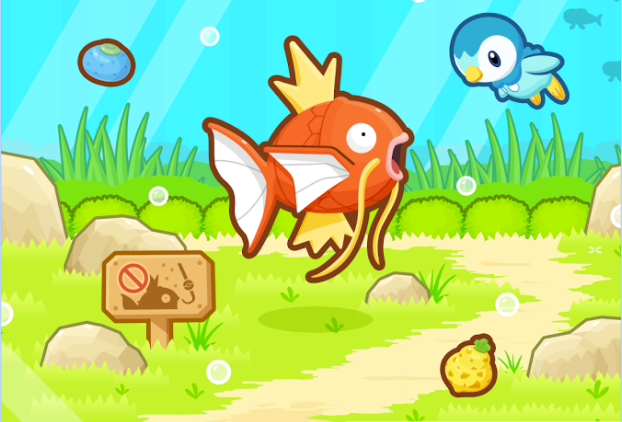
Man, why don't more Pokémon games relax a little and have some enjoyment? Magikarp Jump (2017) was a uncommon case of The Pokémon Company giving its blessing a game with a concept so silly, it was bordering on shitpost. And when we're dealing with a franchise where trainers venture forth with a team of ineffective monsters who simply cannot do anything, I'm shocked we don't have more Pokémon games that laugh at themselves.
Within Magikarp Jump, the player is charged with raising the ultimate version of the notorious fish. I'm not talking about a Magikarp that can kick your butt. These are 'karp raised to enter competitions to see who can flop the highest. I'm not a fan is how Magikarp Jump, like many phone games, requires the player to wait before they can improve their Magikarp further. But it is clear throughout the experience that Select Button appreciated and got the fan culture around Magikarp.
Nowhere was this more evident than in Jump's merciless random events, where your Magikarp was just as likely to raise its stats as it was to get snatched by a Pidgeotto. Beyond the great writing, Magikarp Jump also tried out other things one might wish the core series would do, like offering a diverse range of the same species of monster. I know it's not feasible for any Pokémon game to have 30 different variations for a roster of over a thousand creatures, as Magikarp Jump does... but one can dream.
Magikarp Jump was not a particularly sophisticated or profound game, but the kernels of genius were there. Sharply written events with unpredictable results that forever alter how you can raise a pet also describe the excellent Mewgenics. It's worth noting: Mewgenics will likely be in the conversation when Game of the Year season arrives.
Given dozens of core games and spin-offs, it's probable that I didn't mention that one Pokémon game you totally love but contend that too few people played. It's acknowledged that some people remember games like Pokemon Ranger or Pokémon Pinball fondly notwithstanding argu
